 My
Best proposal software for freelancers, by price
Documentation guide, not a bake-off. Three price lists were read from the rendered pages on October 25, 2026, and no account was opened on any of them. This is the fourth cluster built on the three honest positions this blog works to. The top pick for one person is Better Proposals. Its entry plan is $13 per user per month billed annually, it is capped at a single seat, and signatures and card payments are included at that step. Qwilr is the pick if you send a lot of proposals or cannot predict how many. Its one-seat plan is $35 USD a month billed annually and it places no printed limit on pages you build yourself. Proposify is the pick only if a client will ask for a SOC 2 attestation. It is the dearest entry at $468 per user per year and the only one whose page names the audit. All three charge per seat, all three offer a 14-day trial with no card, and none of the three publishes a free plan. Those three facts rule out most of the shortcut answers.
Our picks
- Best for a freelancer sending ten proposals a month: Better Proposals
- Best if you cannot predict how many proposals you will send: Qwilr
- Best if a client asks for a SOC 2 report: Proposify
The three at a glance
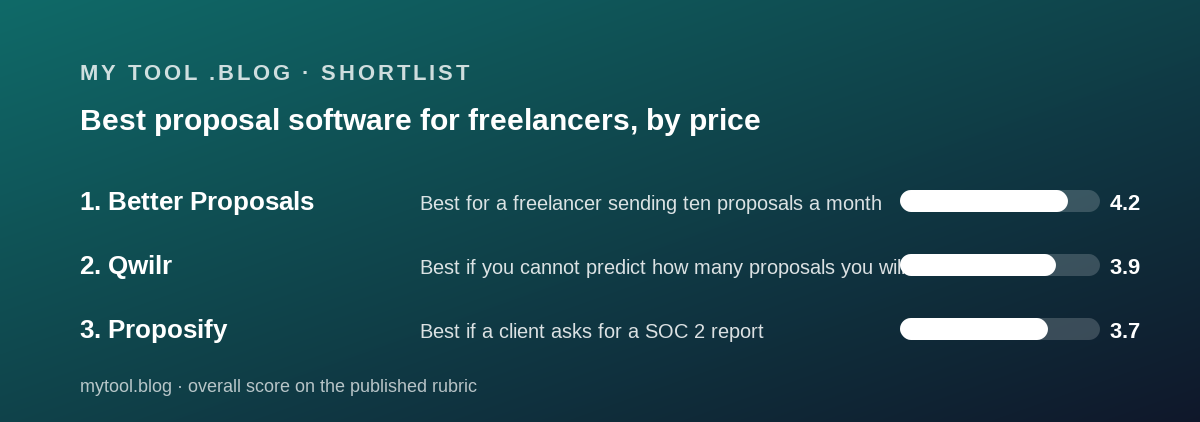
One line each, then the method, then the reasoning in full.
Better Proposals is the cheapest and the only one sized for a single seat: $13 per user per month billed annually, ten sends a month, signatures and payments included. Read the Better Proposals review.
Qwilr is the one that never counts your output: $35 USD per user per month billed annually, one seat, unlimited hand-built pages on every tier. Read the Qwilr review.
Proposify is the one with the paperwork: $468 per user per year, SOC 2 Type 2 named on the page, rolling send allowances, and two sets of plan names. Read the Proposify review.
For the two cheapest set against each other row by row, Better Proposals against Qwilr works both price lists through, including where the crossover sits.
How we picked, and what that does not cover
We did not run tests of our own. Grades come from pricing pages, feature comparison tables, footnotes and pricing FAQs read from the rendered pages on October 25, 2026. No account was opened on any of the three services.
The yearly cost for one sender carries the most weight. Almost every reader of this blog is one person who needs one person to send documents. A per-seat list price for a team of ten is not the number that decides anything here.
What the entry plan caps comes second. A plan that allows ten sends a month is a working tool for a consultant who quotes a job a fortnight. It is not a working tool for a designer quoting three a week.
How many of the page's own numbers survive checking comes third. We multiply monthly rates by twelve, divide platform fees by included seats, and compare discount labels against printed pairs. All three pages failed at least one of those.
Support in writing comes fourth. We grade what the page commits to in text, not what an unlabelled tick icon in a grid implies. None of the three publishes a response-time commitment at any price.
One method note is worth repeating. All three pages draw their prices after the page loads, so an ordinary machine read returns a pricing page with no prices on it at all. Everything here was read from the rendered page.
Why Better Proposals sits first
Because $156 a year is less than half of what the next pick charges, and because the plan is honest about its size.
Starter is $13 per user per month on the annual toggle and $19 monthly, with both figures printed in the same cell of the plan comparison table. That is $156 against $228 a year, by the editors' arithmetic.
The row that matters most is called Maximum user seats, and the Starter column reads 1. Software priced per seat usually hides its minimum until checkout. Here the entry plan simply refuses to grow.
For one person with no staff, a plan that cannot be upsized by accident is a feature. It is one fewer number to misread on an invoice.
The capability is not thin either. A block titled Included on every plan lists the whole editor, unlimited saved templates, the content library with no limits, open tracking, live notifications, card payments and legally binding signatures.
The ceiling is sends. Ten a month on Starter, fifty on Premium at $21 a seat, and Unlimited only on Enterprise at $42. Ten a month is 120 documents a year, by the editors' arithmetic.
Three things on the page do not hold up. The annual toggle claims up to 35 percent when the best printed pair gives 31.6 percent. The support promise appears as both 24 hours a day and 20 hours a day.
And the fourth plan card prints 10,000 against a unit reading per user per month, while the page markup holds 100 for the monthly toggle. We publish no price for that tier, and would not budget from it.
Why Qwilr sits second
Because it costs $264 a year more and removes the one limit that will actually interrupt your work.
Starter is $35 USD per user per month billed annually, or $49 monthly, which the pricing FAQ states in plain text. That is $420 a year against $588, by the editors' arithmetic.
The first row of its feature table is Pages, described as create as many shareable, link-based pages as you need, no limits, with Unlimited printed in all three columns.
That reverses the price comparison above a certain volume. Unlimited sending costs $504 a year at the top pick and $420 here. The crossover sits at around fifty documents a month.
The page is also easy to misread in a way that costs the product a sale. Its $2.50-a-document rate sits under a heading reading API and Automated Document Creation, with 40 free documents on annual Starter.
In other words, the meter bills documents a machine made, not proposals you typed. All four printed credit bundles multiply out exactly, which is the sign of a page written by somebody checking.
Its 29 percent annual discount label is the only one of the three that survives arithmetic. $35 against $49 is 28.6 percent, which rounds honestly.
The costs are narrow but real. Support on Starter is printed as help documents only. Payments collected through the vendor's own gateway carry a 0.09 percent application fee on Starter and nothing above it.
And the step up is a wall. Growth is $55 USD a seat with a five-seat minimum on annual billing only, which is $3,300 a year whether or not five people exist.
Why Proposify sits third
Because it is the dearest entry of the three and the hardest page to read, despite being the best documented product.
Build is $39 per user per month billed annually, printed on the card as $468 per user per year. Thirty-nine times twelve is 468, so that pair is internally consistent.
The quarterly option beside it is the trap. $147 per user per quarter is four payments of $147, which is $588 a year, exactly the monthly rate and $120 more than the annual plan.
The toggle calls annual billing three months free. Three months off a twelve-month list price at $49 would be $441. The printed figure is $468, which is a 20.4 percent saving rather than 25 percent.
What the extra money buys is the only security disclosure of the three worth the name. The page states SOC 2 Type 2 certification, names the AICPA Trust Services Criteria, and names Stripe at PCI Service Provider Level 1.
That is worth almost nothing to a freelancer invoicing small businesses and a great deal to one bidding on a bank. Price it for your actual clients, not for the clients you want.
One other feature here is genuinely best in class. The FAQ states that unused monthly sends accumulate, so a quiet February pays for a loud March. Neither rival page offers that.
The reason it ranks last is readability. The plan cards read Build, Grow and Scale. The send-limit table below reads Basic, Team, Business and Enterprise, and the FAQ sides with the table.
Nothing on the page maps the two sets of names, so a reader cannot tell how many sends come with the plan they are about to buy. Get that in writing before the first charge.
Two smaller problems finish the case. The header invites you to get started for free when no free plan exists anywhere on the page. And support hours end Friday at 4pm Eastern, with no weekend cover at any price.
The arithmetic that actually decides this
Three sums, and they settle it faster than any feature table.
Under ten sends a month: $156 a year at Better Proposals Starter. Nothing else in this cluster is within $264 of that.
Between ten and fifty sends a month: $252 a year at Better Proposals Premium, which also removes the vendor badge from your documents. Still cheaper than either rival's entry plan.
Above fifty sends a month, or unpredictable: $420 a year at Qwilr Starter, against $504 for the only Better Proposals tier that stops counting. Qwilr wins by $84.
Every figure in those three lines is the printed monthly rate multiplied by twelve, by the editors' arithmetic, from pages read on October 25, 2026.
Three we did not rank, and why
All three are already reviewed on this blog, and each solves a nearby problem rather than this one.
PandaDoc is the only tool in this neighbourhood with a genuine free plan, at five documents a month, and it signs as well as proposes. It was ranked in the e-signature guide instead, where its free tier came first.
Bonsai is a freelance suite rather than a proposal tool: proposals, contracts, invoicing and time tracking in one subscription. If you would otherwise buy three tools, run that total before buying any of the three above.
SignWell is the cheapest way to get a contract signed, and nothing more. If the quote is already a PDF you are happy with, SignWell against Dropbox Sign is the comparison to read instead of this one.
How to choose without paying for the same job twice
Four questions, in the order that saves the most money.
How many proposals did you actually send last quarter? Count them before you shop. The answer decides between a $156 plan and a $420 one, and most people guess high.
Does your invoicing tool already send estimates? Several do. If the estimate your accounting software produces is good enough, the proposal subscription is a duplicate. The invoicing guide covers that shelf.
Does the client need to sign, or just to say yes? All three include signatures at the entry price, so a separate signature subscription on top is usually waste.
Will anyone ask you for a security attestation? If not, the dearest option in this cluster is selling you something you will never use. If yes, it is the only one that answers the question.
The general version of this test is in what a tool costs besides its price, and the test for leaving is in how to decide to cancel a tool you already pay for.
What none of the three publishes
Four gaps, identical across all three pages, and worth knowing before you commit a year.
None publishes a support response-time commitment you could hold them to. Better Proposals prints two minutes as marketing copy in a feature block, which is not a service level.
None publishes an uptime figure on its pricing page. For a product whose output is a live link sitting in front of a paying client, that is a real omission.
None publishes an aggregate user rating we could verify. Qwilr prints 4.6 out of 5 from 936 G2 reviews, which at least names a source. Better Proposals shows a star image whose alt text reads 4.8 stars on Capterra.
The G2 and Capterra profiles for all three products were requested on October 25, 2026 and every one returned a bot wall rather than a page. So no score in this guide rests on independent user evidence.
Bottom line
Buy Better Proposals unless you know you will outgrow it.
$156 a year gets one seat, ten sends a month, signatures, card payments and read tracking, with no seat minimum to trip over and no per-document meter. For most freelancers that is the whole answer.
Move to Qwilr at $420 a year if your sending is heavy or unpredictable, because unlimited pages there cost less than unlimited sends at the cheaper vendor.
Pay Proposify's $468 only if a client or a tender will ask for the SOC 2 report, in which case it is the only one of the three that has the answer printed.
And take all three trials inside one fortnight. Each is 14 days with no credit card, which is enough time to send one real proposal and to ask support a question at an awkward hour.
Sources
Better Proposals pricing page, including four plan cards, the monthly and annual values held in the toggle markup, the full plan comparison table, the included-on-every-plan block, two paid extras and the pricing FAQ. Read from the rendered page on October 25, 2026.
Qwilr pricing page, including three plan cards, the full feature comparison table, the credit-bundle list and eleven pricing FAQ answers. The $49 monthly Starter rate comes from the FAQ answer titled how does annual pricing work. Read the same day.
Proposify pricing page, including three plan cards with both billing toggles, the send-limit table, the compare-plans strip, the feature comparison table, the security block and the pricing FAQ. Read the same day.
G2 and Capterra profiles for all three products were requested the same day and returned no readable page. Unlabelled tick and cross icons in feature grids were not interpreted on any of the three pages.
All arithmetic described as the editors' is ours, computed from figures printed on those pages. No account was opened on any of the three services, free or paid.
Best for a freelancer sending ten proposals a month: Better Proposals
The cheapest entry of the three, at $13 per user per month billed annually or $19 monthly, which is $156 a year by the editors' arithmetic.
It is also the only one whose entry plan is openly capped at a single seat, so nobody buys a team plan by accident.
Signatures, card payments, tracking, unlimited templates and the content library all sit in a block the page calls included on every plan.
The limit is sends: ten a month on Starter, fifty on Premium, unlimited only on Enterprise at $42 a seat.
It sits first because it is cheaper at every tier, and because a freelancer sending under fifty documents a month will never reach its ceiling.
Visit Better Proposals
We have no affiliate relationship with this vendor. Link goes to the official site.
Best if you cannot predict how many proposals you will send: Qwilr
Starter is $35 USD per user per month billed annually, or $49 monthly, which is $420 a year by the editors' arithmetic.
One seat is included, and the first row of the feature table reads Unlimited pages on all three plans, described as no limits.
The per-document charges that make this page look expensive sit under a heading about the API and automated document creation, so hand-written proposals are not metered.
Its annual discount label of 29 percent is the only one of the three that survives a check.
It sits second on price and first on honesty: $420 a year for unlimited sending beats the $504 the top pick charges for the same freedom.
Visit Qwilr
We have no affiliate relationship with this vendor. Link goes to the official site.
Best if a client asks for a SOC 2 report: Proposify
Build is $39 per user per month billed annually, printed on the card as $468 per user per year, and 39 times 12 is 468.
That pair is the one piece of arithmetic on the page that checks out cleanly.
What you buy for the extra money is paperwork. It is the only pricing page of the three that names SOC 2 Type 2 and the AICPA criteria it was audited against.
It also names GDPR compliance and Stripe at PCI Service Provider Level 1, and it is the only one whose unused monthly sends roll over.
It sits third because it is the dearest entry, because its page prints two different sets of plan names, and because support closes on Friday afternoon.
Visit Proposify
We have no affiliate relationship with this vendor. Link goes to the official site.
How we chose
Grades come from vendor pricing pages, feature comparison tables, footnotes and pricing FAQs read from the rendered pages on October 25, 2026.
We did not run tests of our own, and no account was opened on any of the three services.
Four criteria carry the ranking. First, the yearly cost for one sender on the cheapest usable plan. Second, what the entry plan caps.
Third, how many of the page's own numbers survive being checked against each other. Fourth, what support is promised in writing rather than implied by an unlabelled icon.
Frequently asked
What is the cheapest proposal software for a freelancer?
Of the three price lists read on October 25, 2026, Better Proposals Starter at $13 per user per month billed annually. Editorial arithmetic: $156 a year. Qwilr Starter is $420 and Proposify Build $468.
Can I use proposal software for free?
Not on these three. All offer a 14-day trial with no credit card and none prints a free plan. PandaDoc does publish a free tier of five documents a month, covered in its own review on this blog.
Do I need proposal software if I already have an e-signature tool?
Only if the quote is the bottleneck. A signature service sends and signs a document. A proposal tool adds interactive pricing the client can adjust, read-time analytics and a card payment inside the page.
How many proposals a month can I send on the cheapest plans?
Ten at Better Proposals Starter and ten on the Proposify tier its table calls Basic. Qwilr prints no limit on pages you build yourself, which is why it wins above fifty a month.
Is annual billing worth it for proposal software?
Usually, but check the label. Entry-tier savings against the monthly rate work out at 31.6 percent for Better Proposals, 28.6 percent for Qwilr and 20.4 percent for Proposify, by the editors' arithmetic.
Which proposal tool has the best support for one person?
None commits to a response time you could enforce. Better Proposals promises a human round the clock in one block and 20 hours a day in another. Qwilr prints help documents only on Starter.