 My
MyWhat I Will and Will Not Claim on This Blog
This is the first post on this blog and it is not a review. It is the list of promises I am prepared to keep, written down now, while there is no traffic to lose by keeping them. Rules written after the audience arrives are negotiable. Rules written before it does are a little harder to quietly drop. If anything published here later contradicts this page, this page is the one that is correct, and you are welcome to hold me to it in public.
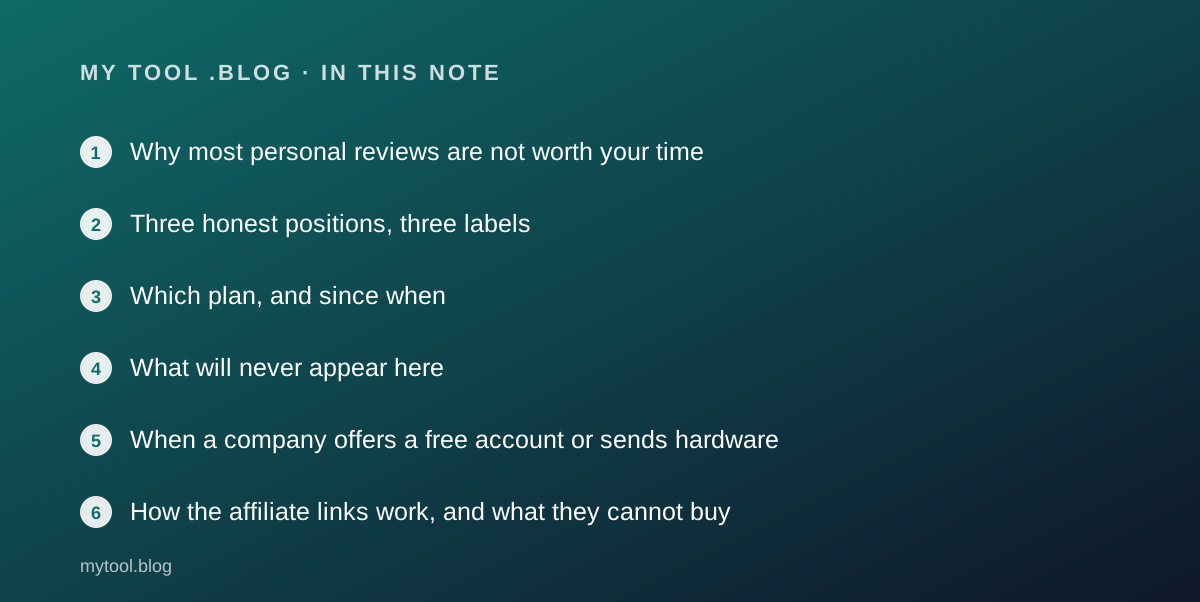
Why most personal reviews are not worth your time
The genre has a structural problem, and it is worth saying out loud before I ask you to trust anything on this domain.
A post that says a tool is fine earns nothing. A post that says a tool transformed somebody's working life earns a click, a share, and sometimes a commission. So the writing drifts steadily toward the second kind, and it drifts there whether or not the writer ever opened the software.
You can usually spot it, and the tell is not bad grammar. The tell is absence. The post never says which plan the writer was on. It never says when. It never names one thing the tool flatly refuses to do, because refusals only get discovered by somebody working to a real deadline. It recommends every product it touches. The screenshots are the ones from the vendor's own home page, cropped a little tighter.
I am not claiming to stand above any of this. The incentive lands on me exactly as hard as it lands on everyone else. What I am claiming is that the fix is boring, cheap and checkable: say what you did, say plainly what you did not do, and put the difference at the top of every single post so a reader never has to guess which kind they are holding. That is the whole idea behind this page, and behind the editorial policy it sits beside.
Three honest positions, three labels
There are only three honest positions a writer can occupy with a piece of software, so there are only three kinds of post on this blog. Each kind carries its label in the opening lines, where you will see it, not in a footer at the bottom of a page nobody reaches.
The label matters more than any score. A warm paragraph from somebody on a free plan and a lukewarm paragraph from somebody who has renewed a paid plan for years are not the same evidence, and no star rating can carry that difference. So the labels do the work instead.
- Paid and in use. My own money, my own card, the tool currently on my desk. The post names the plan and says roughly how long the subscription has been running. This is the only label under which I will ever tell you a tool is worth paying for.
- Free plan only. An account on the free tier and nothing beyond it. A post like this can describe signing up, the shape of the thing, and exactly where the free ceiling sits. It cannot tell you whether the paid plan earns its money, and it will say that in those words rather than implying otherwise and hoping you do not notice.
- Documentation only. No account at all. Read from the vendor's own pricing page, help centre, changelog, terms and status history, plus credible reports from people who do use it daily. These posts exist because a reader choosing between two tools is better served by a careful reading of both sets of documents than by silence. They are never dressed up as experience, and they never carry a verdict that only experience could support.
Which plan, and since when
A review with no date is a rumour. Software changes under the article while the article sits still, collecting search traffic and getting less true every month.
So every post here carries two facts near the top: the plan the writing is based on, named the way the vendor names it, and the date the claims were last checked. Not the publication date, which only tells you when somebody was motivated to write. The checked date, which tells you when somebody last looked.
When a post goes stale I have two options and only two. Recheck it and move the date, or mark it clearly as a record of how things were and stop recommending it. Quietly leaving an old verdict in place while the product moves on is the most common form of dishonesty in this genre, and it requires no lying at all. It only requires neglect.
The plan name matters as much as the date. Vendors shuffle tiers, rename them, and move one critical feature up a level. A verdict reached on a tier that no longer exists is not a verdict about anything you can buy. If that happens, the post says so at the top rather than pretending the old sentence still applies.
What will never appear here
This is the part of the page I expect to be judged against, so it is written as flatly as I can manage. These are not aspirations. They are refusals.
- An invented trial. No claim of experience with a product nobody here ever opened, in any tense, in any grammar. That includes the passive dodge, because "the app was put through a busy week" is the same false claim wearing a hat.
- A figure I cannot source. No prices, speeds, user counts or benchmark numbers recalled from memory or borrowed from another article. If a number appears in a post here, it came from a named document and the post names it, so you can check whether it still says that.
- A ranking moved by money. A tool will never climb a list because it pays better, and no tool will ever be added to a list because somebody asked.
- A manufactured deadline. No countdowns, no "ends tonight", unless the vendor's own page says so and the post links to the page saying it.
- A sponsored post shaped like a review. If a company ever pays for placement, the post will be labelled as an advertisement in the headline, and it will not carry a verdict.
- A testimonial from somebody who does not exist. No invented customers, no invented colleagues, no composite quotes assembled to sound like a crowd.
- Confident advice about work I do not do. This blog is written from independent work: invoicing, contracts, scheduling, writing, getting paid. Procurement software for large organisations is somebody else's beat, and pretending otherwise would be the easiest way to be wrong at length.
When a company offers a free account or sends hardware
This will happen, and the policy should exist before the first offer arrives rather than be improvised while a nice email sits open.
A free account provided by a vendor does not become "paid and in use". It gets its own line at the top of the post saying the access was provided, by whom, and for how long. Access given to me is not the same as access you would pay for, because the account somebody set up to be looked at is rarely configured like the account you will live in.
Hardware, if it ever turns up, gets disclosed the same way, and the post says whether it went back.
Three things are not on the table. No copy approval: nobody outside this blog sees a draft before it publishes, including the company being written about. No veto on criticism, written or implied, as a condition of access. No embargo that requires agreeing in advance to a framing.
If refusing those costs me access, that is a real cost and I accept it. A blog that can be edited by the companies it covers is a marketing channel with a personal byline on it, which is already a crowded field and does not need another entry. The fuller version of this sits on the about page.
How the affiliate links work, and what they cannot buy
Some links here pay a commission if you buy through them, at no extra cost to you. That is how this blog intends to pay for itself, and saying so vaguely at the bottom of a page is not a disclosure, so here is the mechanism.
The order of operations is fixed: the opinion is formed first, written down, and only then does anyone check whether a commission link exists. The link is plumbing added at the end. It cannot reach back up the page and change a sentence.
Which means the ranking is decided before the money is known, and I would rather publish a list whose top pick pays nothing than explain away a list that happens to be sorted by commission rate. Plenty of good tools for independent workers run no affiliate programme at all. Those get reviewed on the same terms, linked straight to the vendor, and the post says plainly that there is no commission on that one, because claiming a relationship you do not have is its own kind of false statement.
Two more limits. A tool never enters a comparison because it pays. And a negative verdict never gets softened because a commission is attached to the softer version.
Reading a post here in two minutes
Nobody reads a software review end to end, and designing for the pretence that they do is how reviews get bloated. Posts here are built to be skimmed in a fixed order, and this is the order.
- The label line. First thing on the page. Paid and in use, free plan only, or documentation only. It tells you how much weight the rest can carry.
- Who it is not for. Every post has one. If you are in that sentence, you can stop reading and keep your afternoon.
- The checked date. If it is old and the product is busy, treat everything specific as a lead to verify rather than a fact.
- The part where it refuses. The section on what the tool will not do is the most useful section in any review, and the one most often missing elsewhere.
- Kept or cancelled. Whether the subscription is still running, and if not, what finally ended it.
- The money note. Whether a commission link is on the page. It should not change your reading, but you are entitled to know before you decide that.
Cancelled is a verdict, not a failure
The most useful sentence a reviewer can write is also the one almost nobody writes: I stopped paying for this, and here is what finally did it.
Software recommendations are overwhelmingly written at the moment of maximum enthusiasm, which is the first fortnight, when everything is new and nothing has gone wrong yet. That is the least informative moment in the whole relationship. The informative moment is the renewal, when the novelty is gone and the charge appears anyway and you have to decide on purpose.
So cancellations get published here, including cancellations of tools this blog has recommended. When that happens, the original post gets a dated note at the top rather than a quiet rewrite, because a reader who acted on the old advice deserves to see that the advice moved and why.
It follows that a tool still on the desk after a long time counts for more here than any feature list, and considerably more than a launch-week impression. Survival is the only test that cannot be faked by good onboarding.
When I get it wrong
I will get things wrong. The question a reader should care about is not whether a blog makes mistakes but what it does on the morning it finds one.
Corrections here are made in place, with a dated note at the top saying what the post used to claim and what it claims now. No silent edits. If a whole conclusion flips, the old conclusion stays visible with a line through it rather than vanishing, because a disappearing mistake is indistinguishable from never having made one, and that is exactly why it is tempting.
Factual corrections get made regardless of who asks or how politely. A vendor's PR team pointing out a genuine error is still pointing out a genuine error, and the correction does not come with a softened verdict attached as a courtesy. Opinions, on the other hand, are not corrected on request. Disagreement is not an error, and a request to change a judgement gets published alongside the judgement if it is interesting.
The address for all of this is on the contact page. Corrections go to the front of the queue, ahead of pitches.
Questions to ask any review blog, including this one
If you take nothing else from this page, take the checklist. It works on this blog and it works on every other one, and most of them fail it inside a minute.
- Does the post say which plan or version the writing is based on, by name?
- Does it say when the claims were last checked, separately from when the post was published?
- Does it name one thing the tool will not do, specifically enough that you could verify it?
- Has this site ever published a negative verdict, or a cancellation, on a product it previously recommended?
- Are the screenshots and photographs the vendor's marketing assets, or somebody's actual screen?
- Is there a commission disclosure, and does it appear before the recommendation rather than after it?
- Can you find a corrections policy, and any evidence that it has ever been used?
- When the site has no first-hand experience, does it say so plainly, or does it go quiet and let the prose imply otherwise?
What this blog is for
One person's working notebook about the software that independent work actually runs on, written for the reader who has to pay for it out of the same account that pays for everything else.
That reader does not need enthusiasm. They need to know what a tool costs when the introductory period ends, which of their existing things it will refuse to talk to, what happens to their data if they leave, and whether anyone sticks with it past the second renewal.
So the reviews will be slower to arrive than they would be if I were willing to write them from a pricing page. Where there is no first-hand use yet, posts will carry the documentation label and read the vendor's own paperwork closely, which is genuinely useful and is not the same thing as experience. The difference will always be stated, never implied.
That is the deal. Rules first, reviews after.