 My
Better Proposals vs Qwilr: which fits one person
Both price lists were read from the rendered pages on October 25, 2026. No account was opened on either service. That is the documentation standard on this blog, the third of the three honest positions. The short answer is that one number decides it, and the number is how many proposals you send a month. Better Proposals is best if you send fifty documents a month or fewer. Its one-seat Starter plan is $13 per user per month billed annually, and Premium at $21 lifts the ceiling to fifty sends. Qwilr is best if you send more than that, or cannot predict it. Starter is $35 USD per user per month billed annually and the Pages row of its feature table reads Unlimited on every plan. The crossover is sharper than it looks. Unlimited sending costs $504 a year at Better Proposals and $420 at Qwilr, by the editors' arithmetic on the printed annual rates.
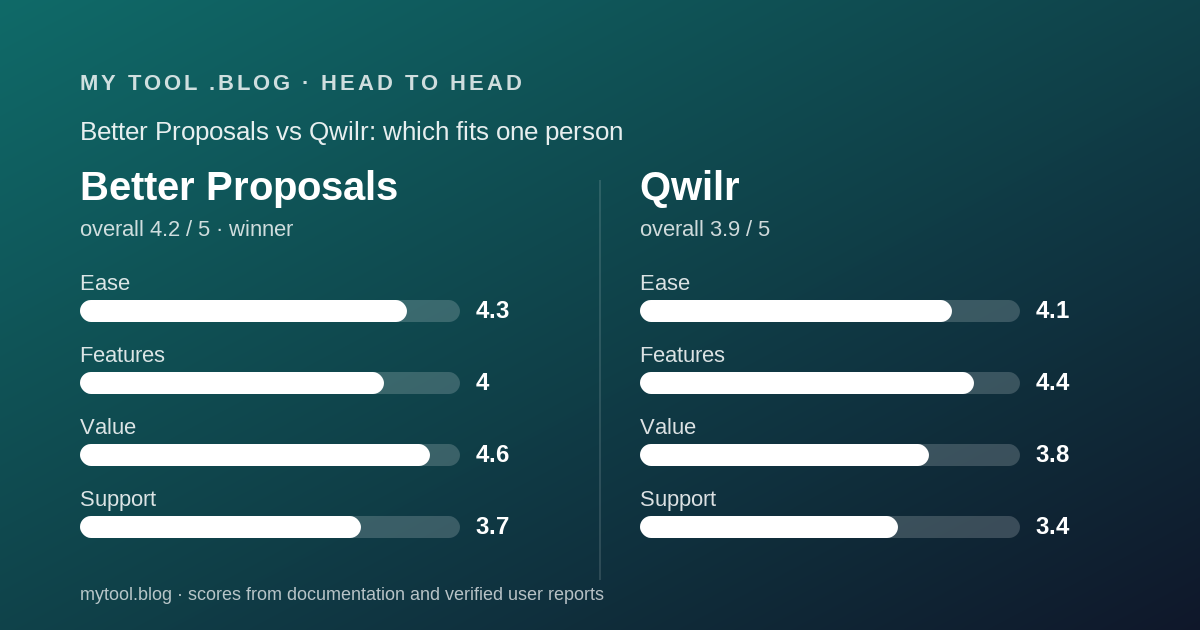
 4.2Better Proposals
 3.9Qwilr
Specification by specification
| Spec | Better Proposals | Qwilr |
|---|---|---|
| Entry price, billed annually | $13 per user per month | $35 USD per user per month |
| Entry price, billed monthly | $19 per user per month | $49 USD per user per month |
| Entry price as a yearly total (editors' arithmetic) | $156 | $420 |
| Free plan | None; 14-day trial, no card | None; 14-day Starter trial, no card |
| What happens to your work when the trial ends | Not stated on the pricing page | Pages stay live 30 days; account access ends |
| Seats at the entry price | Capped at 1 | 1 included |
| Seat rule on the next tier up | Premium prints Unlimited seats | Growth requires a 5-seat minimum, annual only |
| Documents you may send per month at the entry price | 10 | No limit printed on hand-built pages |
| Cheapest plan with no send ceiling | Enterprise, $42 per user per month annually | Starter, $35 USD per user per month annually |
| Per-document charges | None printed | $2.50 USD a document for automated creation; 40 included on annual Starter |
| Vendor fee on payments you collect | None printed | QwilrPay application fee 0.09% on Starter, 0% above |
| Removing the vendor's branding | Premium, $21 per user per month annually | Custom branding is named in the Growth column |
| Annual discount: label against printed prices | Label up to 35%; entry pair gives 31.6% | Label 29%; entry pair gives 28.6% |
| Support promised in writing at the entry price | 24 hours a day in one block, 20 hours a day in another | Help documents only |
What this comparison is, and what it is not
It is a reading of two price lists, side by side, on one date.
Both pages draw their prices after load, so both were opened in a real browser engine on October 25, 2026. A plain machine read of either returns a pricing page with no prices on it.
No account was opened on either service. Nothing here describes what the two editors feel like, how fast either one loads for a client, or which one makes a nicer page.
What a careful read of two price lists does tell you is what each company will charge you, what it will cap, and what it has committed to in writing.
For a freelancer deciding where $156 or $420 a year should go, that is usually the deciding evidence.
The full single reviews are Better Proposals and Qwilr.
Better Proposals is cheaper at the bottom by a factor of nearly three
On the entry plan the gap is not close.
Better Proposals Starter is $13 per user per month billed annually, or $19 monthly. Qwilr Starter is $35 USD per user per month billed annually, or $49 monthly.
By the editors' arithmetic those are $156 and $420 a year. The difference, $264, is more than the whole cost of the cheaper subscription.
Both plans include exactly one seat, both include e-signature, both include payment collection, and neither has a free tier.
So at first glance this is a rout. The second glance is what the rest of this article is about, because the cheaper plan is also the one that counts your documents.
Qwilr does not cap how many proposals you send; Better Proposals does
This is the single fact that reverses the price comparison for some readers.
The first row of Qwilr's feature table is Pages, described as create as many shareable, link-based pages as you need, no limits. All three columns read Unlimited.
Better Proposals prints a row called Monthly Send Limit, and it reads 10 on Starter, 50 on Premium and Unlimited on Enterprise.
Ten a month is 120 documents a year, by the editors' arithmetic. A consultant who writes a proposal a fortnight will never notice. A designer quoting three jobs a week is over the limit in the first month.
Neither page describes drafting as metered. The Better Proposals limit falls on sending, and the Qwilr meter, discussed below, falls on machine-generated documents rather than on anything you typed.
The crossover sits at fifty sends a month, and Qwilr wins above it
Work the ladders against each other and the decision becomes arithmetic rather than taste.
Under ten sends a month, Better Proposals Starter at $156 a year is the answer, and nothing else is close.
Between ten and fifty, Better Proposals Premium at $21 per user per month annually, or $252 a year, is still well under Qwilr's $420.
Above fifty, Better Proposals requires Enterprise at $42 per user per month annually. That is $504 a year, by the editors' arithmetic, against $420 for a Qwilr Starter plan that was never counting in the first place.
So Qwilr is the cheaper unlimited plan by $84 a year. If your sending is unpredictable, the plan that does not count is worth paying for even at a higher sticker price.
Qwilr's per-document pricing is easy to misread, and misreading it costs you the product
A skim of the Qwilr page suggests it charges $2.50 per proposal. It does not.
Those rows sit under a heading that reads API and Automated Document Creation, beneath rows about API access and what the vendor calls the Smart Proposal Engine.
The free documents row reads 40 on Starter, 200 on Growth and 600 on Scale. Pay as you go is $2.50 USD a document on all three plans, and bundles bring it to $2 at 250 documents for $500.
All four printed bundle pairs multiply out exactly, by the editors' arithmetic: 250 at $2 is $500, 1,000 at $1.80 is $1,800, 2,000 at $1.60 is $3,200, 5,000 at $1.50 is $7,500.
A freelancer writing proposals by hand touches none of this. One footnote matters, though: generating pages from templates through the vendor's AI assistant connector does draw on the same credits.
Better Proposals prints no per-document charge anywhere, and lists an API and an MCP server with no usage fee attached.
Both annual discounts are checkable, and only one survives intact
This is a small test that tells you how carefully each page was written.
Qwilr's Starter card says save 29 percent. The FAQ gives $35 annually against $49 monthly. That is 28.6 percent, by the editors' arithmetic. The label rounds, and it rounds honestly.
Better Proposals' toggle says save up to 35 percent. The printed pairs give 31.6 percent on Starter, 27.6 percent on Premium and 14.3 percent on Enterprise.
No plan on that page reaches 35 percent. The words up to carry the claim, and they point at nothing.
Qwilr adds a second annual penalty that is unusually blunt. Its free-documents row notes that Starter plans billed monthly do not include free documents, so the monthly route costs 40 percent more and loses the 40 credits.
Better Proposals has the better exit at the entry price; Qwilr has the better trial
Two different kinds of fairness, and both are worth a line in a budget.
Better Proposals wins on branding. The FAQ says Premium and Enterprise can remove the vendor's logo, so a white-label proposal costs $21 per user per month annually. Keep the badge on Starter and the FAQ offers you a commission when a recipient signs up.
Qwilr names custom branding in the Growth column, which is $55 USD per user per month with a five-seat annual minimum. Its Starter branding rows are unlabelled icons, which we did not interpret.
Qwilr wins on the trial. Both offer 14 days with no credit card. Only Qwilr states what happens afterwards: pages stay live for 30 days while account access ends.
That detail is worth real money. A proposal sent on day thirteen of a trial should not break in front of a client on day fifteen.
Pricing: Better Proposals costs less at every tier, Qwilr charges fewer kinds of thing
Count the meters and the picture changes again.
Better Proposals has two: a seat price and a monthly send allowance. Its paid extras are printed, at $10 per user per month for the Nudge follow-up tool and from $1,495 for custom template design.
Qwilr has three: a seat price, an automation credit meter, and a 0.09 percent application fee on payments collected through QwilrPay on Starter. That fee drops to 0 percent on both higher plans.
Nine hundredths of a percent is $4.50 on a $5,000 project, by the editors' arithmetic. It is not a reason to choose differently, but it is a fee that exists only for the smallest customer.
One card on the Better Proposals page cannot be read at all. Its Elite tier prints 10,000 against a unit reading per user per month, while the page markup holds 100 for the monthly toggle. We publish no price for it.
Support: Better Proposals promises much more and contradicts itself; Qwilr promises little and says so
Neither answer is comfortable.
Better Proposals' included-on-every-plan block promises a two minute response from a human, 24 hours a day, and the FAQ repeats it. The support row in its own comparison table then reads Live Chat, 20 hours a day.
Twenty hours is still the strongest written commitment of the two. But a page that prints both 24 and 20 is a page to verify, not to trust.
Qwilr's Support Provided row prints help documents only in the Starter column. Chat support appears in the Scale column's feature list, and the FAQ puts a dedicated success manager on Growth.
So at the entry price Qwilr commits to documentation and Better Proposals commits to a human, with the hours in dispute. In both cases, the trial is the place to test it. Ask a question at an awkward hour and see what comes back.
Seats: Better Proposals refuses to sell you a second one, which is a feature
Both pages are honest about seats, in opposite ways.
Better Proposals caps Starter at one user seat in its Maximum user seats row, then prints Unlimited for Premium and Enterprise. Adding anybody means moving to $21 per user per month annually.
Qwilr includes one user on Starter and lets you add more at $35 USD each. Its next tier, Growth, states a five-seat minimum, and Scale a ten-seat minimum, both annual billing only.
For one person with no plans to hire, the cap is the safer design. A plan that cannot grow cannot quietly bill you for growth.
Qwilr's FAQ adds an asymmetry worth pricing in advance. Seats added mid-term are prorated, but seat reductions take effect only at renewal, on a plan paid upfront for twelve months.
What neither page tells you
Three things, and they are the same three on both sides.
Neither publishes a support response-time commitment you could hold them to. Better Proposals prints two minutes as marketing copy in a feature block, not as a service level.
Neither publishes an uptime figure on the pricing page. For a tool whose output is a live link in front of a paying client, that is a real omission.
Neither publishes an aggregate user rating we could verify. Qwilr prints 4.6 out of 5 from 936 G2 reviews, which at least names a source.
The G2 and Capterra profiles for both products were requested on October 25, 2026 and both returned a bot wall rather than a page.
So neither score in this comparison is based on independent user evidence. They are based on documents, which is what the label on this blog says.
Choose Better Proposals if, choose Qwilr if
Five conditions, and most freelancers will land on the first list.
Choose Better Proposals if you send ten documents a month or fewer, or if $156 a year is the budget.
It also wins if you want signatures and card payments at the bottom step with no vendor fee on top, or white labelling at $21 a month rather than $55.
Choose Qwilr if your sending is above fifty documents a month, or simply unpredictable.
It also wins if you want an ROI calculator, embedded media and a buyer-editable quote block inside the page itself.
And it wins if you bill in Australian or New Zealand dollars, since the page prices in AUD for those markets, or if knowing what happens when a trial expires is worth the difference.
If neither convinces you, the free route is elsewhere. PandaDoc publishes a five-documents-a-month free tier and signs as well as proposes.
Frequently asked, answered from the two pages
Four questions that a reader comparing these two actually types.
The cheaper one is Better Proposals at every tier. The one that never counts your output is Qwilr. The cheapest unlimited plan across both is Qwilr Starter at $420 a year, against $504 for Better Proposals Enterprise.
Both give fourteen days with no credit card, and only Qwilr says what survives afterwards.
Neither is a signature service first. If what you send is a contract rather than a quote, SignWell against Dropbox Sign is the cheaper comparison, and the e-signature guide ranks that shelf.
If the proposal is only half the problem, the invoicing guide and the FreshBooks review cover what happens after the client says yes.
Bottom line
Better Proposals wins for most freelancers, on volume rather than on taste.
At $156 a year for one seat with signatures, payments and tracking included, it is the cheaper tool for anyone sending under fifty proposals a month. That is most independent workers, most of the time.
Qwilr wins above that line, and wins decisively if your output is unpredictable. $420 a year for unlimited hand-built pages beats $504 for the only Better Proposals tier that stops counting.
What neither page earns is trust in its own claims. One contradicts itself on support hours, seat limits and an entire plan's price. The other prices three separate meters and leaves half its feature grid as unlabelled icons.
Take both trials in the same fortnight. Send one real proposal through each, and count your own sends for a month before you commit to a year.
And if neither earns its keep, Bonsai is the one-subscription alternative that folds proposals in with contracts, invoicing and time tracking.
Sources
Better Proposals pricing page: four plan cards, the monthly and annual values held in the toggle markup, the full plan comparison table, the included-on-every-plan block, two paid extras and the pricing FAQ. Read from the rendered page on October 25, 2026.
Qwilr pricing page: three plan cards, the full feature comparison table, the credit-bundle list and eleven pricing FAQ answers, including the answer titled how does annual pricing work, which is where the $49 monthly Starter rate is printed. Read the same day.
G2 and Capterra profiles for both products were requested the same day and returned no readable page. Unlabelled tick and cross icons were not interpreted on either page.
All arithmetic described as the editors' is ours, computed from printed figures. No account was opened on either service.
Frequently asked
Which is cheaper for one person, Better Proposals or Qwilr?
Better Proposals, by a wide margin at the entry price. Starter is $13 per user per month billed annually against $35 USD at Qwilr, which is $156 a year against $420, by the editors' arithmetic on October 25, 2026.
Which one lets me send unlimited proposals for less?
Qwilr. Its Starter plan at $35 USD a month annually prints Unlimited pages, which is $420 a year. The cheapest Better Proposals plan with unlimited sends is Enterprise at $42 a month annually, or $504 a year.
Does either one have a free plan?
No. Both offer a 14-day trial with no credit card and neither prints a zero-dollar tier, as read October 25, 2026. For a real free tier, PandaDoc publishes five documents a month at no cost.
Does Qwilr really charge $2.50 per proposal?
Only for machine-generated documents. The $2.50 rate sits under a heading about the API and automated document creation. Pages you build by hand are listed as unlimited on all three plans.
Which one can I white-label more cheaply?
Better Proposals. Its FAQ puts branding removal on Premium, which is $21 per user per month billed annually. Qwilr names custom branding in its Growth column, at $55 USD per user per month with a five-seat annual minimum.
Visit Better Proposals
We have no affiliate relationship with this vendor. Link goes to the official site.
Visit Qwilr
We have no affiliate relationship with this vendor. Link goes to the official site.