 My
MyHow to Decide to Cancel a Tool You Already Pay For
This post is a method, not a review. It names no product, quotes no price and carries none of this blog's three labels, because it is not making a claim about any particular tool.
It is about the decision almost every independent worker postpones: whether to keep paying for something that is still, technically, in use. That decision gets made badly because it is usually made at the wrong moment, by someone in a hurry, with the charge already on the card. What follows is a way to make it on purpose instead.
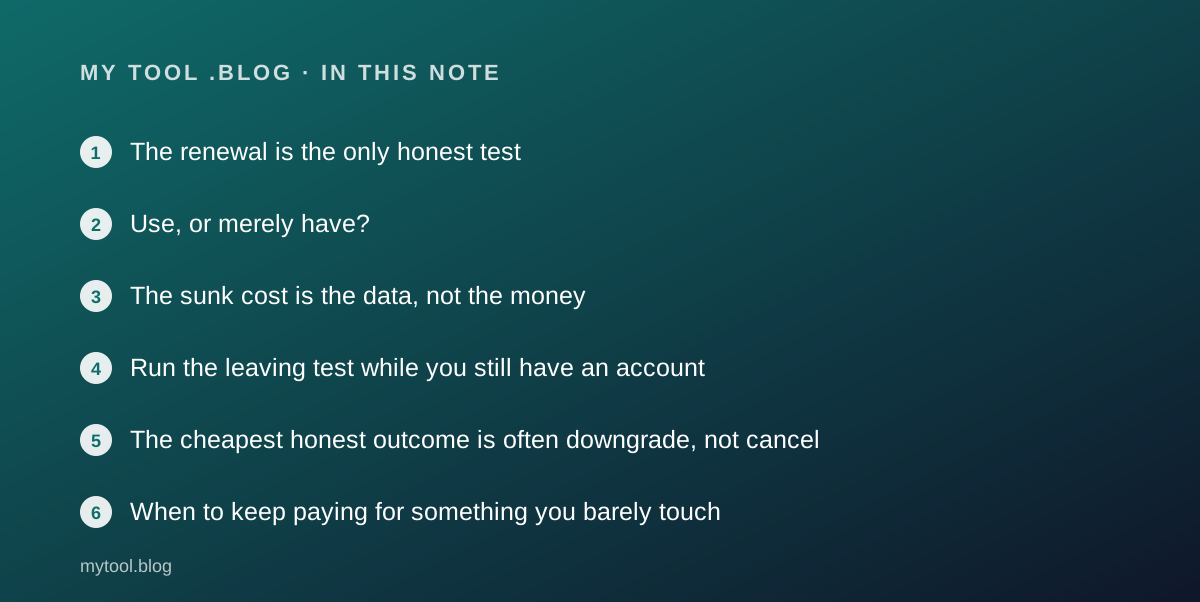
The renewal is the only honest test
Software recommendations are written at the moment of maximum enthusiasm, which is the first fortnight. Nothing has gone wrong yet, the novelty is doing half the work, and the tool is being compared against the mess it replaced rather than against its own cost.
The renewal is the opposite moment, and it is the informative one. The novelty is gone, the mess has been absorbed, and the charge arrives anyway. Deciding on purpose at that moment is the only evaluation that cannot be faked by good onboarding.
Which is why the practical first step has nothing to do with the tool. Find the renewal date for every subscription you hold and put each one in a calendar a week early. A decision you can only make in the four minutes after a receipt lands is not a decision.
Use, or merely have?
There is a category of tool that is neither used nor unused. It is open. It has your data in it. It gets touched most weeks. And if it vanished overnight you would be mildly inconvenienced rather than stuck.
That is the expensive category, because it feels like use and bills like dependency.
The test is not how often you open it. It is what breaks when it is gone.
- Does any client-facing commitment depend on it? If a deliverable, an invoice or a booking goes through it, that is dependency.
- Is it load-bearing for money? Anything in the path between doing the work and being paid for it is worth more than it costs, almost always.
- Would you rebuild it if it closed? If the honest answer is that you would just stop doing that thing, you were not doing that thing.
- Is it the only copy of something? Not a reason to keep paying, but a reason not to cancel until you have exported it.
- Do you open it from habit or from need? Habit is a real cost, and habit is why the charge has survived this long.

The sunk cost is the data, not the money
People talk themselves out of cancelling by counting what they have already paid, which is the one number that is genuinely irrelevant. Last year's money is gone whatever you decide today.
The real anchor is the work living inside the tool: the templates, the history, the saved views, the slowly accumulated setup that made it finally fit. That is not sunk cost. That is an asset with a specific, checkable property, which is whether it can leave.
So the question to answer before you cancel anything is not whether the subscription was worth it. It is whether the thing you built inside it survives the exit. If it does, cancelling is cheap and reversible. If it does not, the subscription is not really a subscription; it is a storage fee, and that is a different decision deserving a different answer.
Run the leaving test while you still have an account
Do this before you cancel, not after, because the export features of a cancelled account are frequently worse than those of a paying one, and sometimes absent.
- Export everything, including the parts you think you will never need. Attachments and history are the usual casualties.
- Open the export in something else. An export you cannot read is a backup of nothing.
- Check what the export omits. Comments, timestamps, links between records and custom fields are the common gaps.
- Find out what happens to the account after cancelling: frozen and readable, downgraded to a free tier, or deleted on a timer.
- Screenshot the handful of screens you actually rely on, so you can rebuild the setup elsewhere from something better than memory.
- Note anything with an external dependency, such as a published link or an embedded form that will break for someone else when you go.
The cheapest honest outcome is often downgrade, not cancel
Cancelling is not the only lever, and it is rarely the first one worth pulling. Many tools have a free tier that is perfectly adequate for the reduced way you are now using them.
That is the move for the merely-have category: drop to free, keep the data reachable, and lose the charge. It takes the pressure off the decision entirely, because you can come back up a tier the month the work comes back.
The other underused lever is billing frequency. Annual billing is usually cheaper and always less reversible. A tool you are uncertain about belongs on monthly billing even at a worse rate, because the premium is buying you the right to change your mind. A tool you are certain about belongs on annual. Being uncertain and on annual is the one combination that costs money for nothing.
When to keep paying for something you barely touch
Three cases where the obvious maths is wrong, and keeping the charge is correct.
The first is insurance. A tool used twice a year at a moment of genuine need, like getting a signed contract back from a difficult client, is not competing with its monthly cost. It is competing with the cost of the thing going wrong.
The second is other people. If clients already have the link, the login or the habit, the switching cost lands on them, and you pay it in goodwill rather than money.
The third is rebuild time. If the setup inside the tool took a long evening to get right and would take another long evening to recreate, that evening has a rate. Compare it with the subscription before congratulating yourself on a saving.
Cancel in a way you can reverse
The failure mode of a good cancellation is losing the thread: three months later you need the thing, cannot remember why you left, and resubscribe into a worse plan than the one you had.
- Export first, cancel second. Always this order.
- Note the plan name you were on, because tiers get renamed and reshuffled and the one you leave may not exist when you return.
- Set a reminder for the end of the billing period you have already paid for; you usually keep access until then and the work is easier to retrieve while you do.
- Write one line about why you cancelled, specific enough to be useful: what it would not do, not merely that it cost too much.
- Check for anything you published through it before the links die quietly for everybody else.
- Diarise one revisit a season later, to decide whether you missed it or imagined you would.
Write the reason down, because it is the only durable finding
The reason you cancelled is worth more than the saving. It is the only output of the whole exercise that is still useful in a year.
That is the thinking behind this blog's rule that cancelled is a verdict, not a failure. A tool that lost its place on the desk tells you something a launch-week impression cannot: what stopped mattering, and what turned out to matter instead.
Kept for a long time is the strongest signal available about software, and it is the one almost nobody records, because keeping something generates no event to write about. A cancellation does. Use it.
Bottom line
Put every renewal date in a calendar a week early, and decide there rather than at the receipt. Ask what breaks when the tool is gone, not how often you open it. Treat the work inside it as the real anchor and test whether it can leave before you decide anything.
Then prefer the smallest sufficient move. Downgrade before cancelling, monthly before annual while you are unsure, and export before either. Keep the charge where it buys insurance, other people's convenience, or an evening of your own time.
And write down why. This blog's reading of two pricing pages in the October 7 journal entry was the same exercise aimed at the other end of the relationship: what a page says before you sign. This one is about the sentence nobody publishes, which is what you learned by the time you left. The rules this blog holds itself to are on the editorial policy page.