 My
Quo Review: What One Person Pays for a Business Line
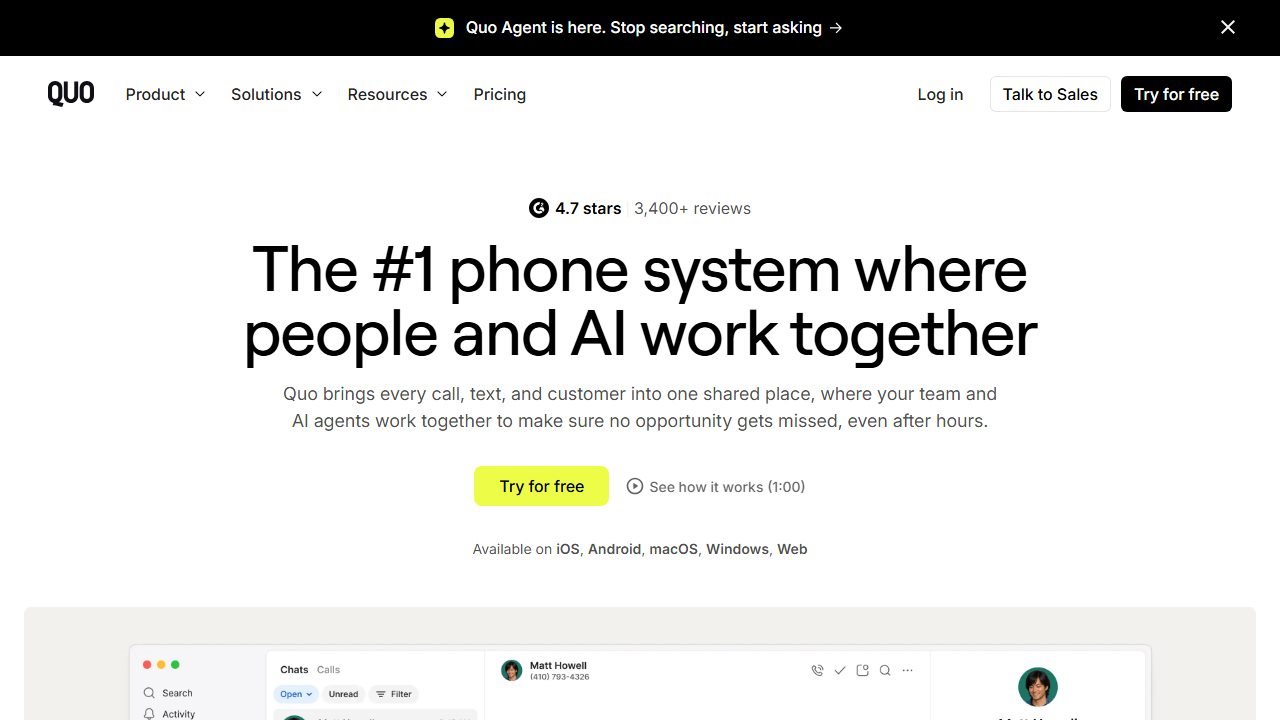
Quo is a business phone system, and for one person the decision comes down to a single number: $19 per user per month, billed annually at $228, as shown on the quo.com pricing page on October 23, 2026.
That buys one local or toll-free number, unlimited calling and texting to US and Canadian numbers under a fair usage policy, and an AI agent called Sona that answers when nobody picks up.
This is a documentation review. Every figure below was read on Quo's own pages on October 23, 2026, and no test of our own was run. Some links on this page are affiliate links; the reading came first, the link went in afterwards.
What Quo is now, after the OpenPhone rebrand
Quo is the product that used to be sold as OpenPhone. The company announced the name change on September 23, 2025, alongside $105 million in growth financing, and wrote that the rebrand "isn't about changing the product you already know and trust."
The shape is unchanged. App-based numbers for iOS, Android, macOS, Windows and the web, one shared inbox per number, and automatic transcripts for voicemail on every plan.
What is new is Sona, an AI agent that answers calls around the clock. On the pricing page read October 23, 2026, Sona appears on all three plans, but with a credit allowance rather than unlimited use.
One sign the rebrand is still unfinished: the plan comparison table on that same page says "your OpenPhone workspace" and "Try OpenPhone risk-free for 7 days," read October 23, 2026. Cosmetic, but worth knowing before you search the help centre.
If you are weighing whether any new subscription earns its place, our note on what a tool costs besides its price is the better place to start than a feature list.
Who it fits, and who should skip it
Quo suits a one-person business that is still handing out a personal mobile number and has started to regret it. The fit gets weaker as calls move outside North America.
- A solo operator giving out a personal number today. One business number, one inbox, and a line you can hand to someone else later without changing your own SIM.
- Anyone selling paid calls. Quo handles the line, not the booking, so it sits alongside a scheduler rather than replacing one — compare the options in our guide to scheduling tools for freelancers.
- Trades and services who miss calls while working. Sona answers and captures details; the included allowance is 1,000 credits, which the pricing page equates to 10 calls.
- Small teams of two to ten. Starter shares a number with up to 10 paid users, per the comparison table checked October 23, 2026.
- People already running on HubSpot or Salesforce. Those integrations begin on Business, $27 per user per month billed annually.
Three readers should close this tab now.
- You want a free number. There is no free tier. The only free access is a 7-day trial.
- Most of your calls leave the US and Canada. Other destinations are charged per minute or per message and billed out of credits.
- Your connection is unreliable. Quo runs over the internet, and dropped calls are the most repeated complaint in public reviews.
What it costs, and the two different prices on one page
The plan cards and the comparison table on quo.com/pricing showed two different sets of prices when we read the page on October 23, 2026. That is the single most useful thing to know before you reach checkout.
The plan cards at the top of the page, with the Yearly toggle on, listed these figures:
- Starter — $19 per user per month, billed annually at $228, badged "Save $108/year".
- Business — $27 per user per month, billed annually at $324, badged "Save $144/year".
- Scale — $36 per user per month, billed annually at $432, badged "Save $144/year".
- Monthly billing on the same cards: $28, $39 and $48 per user per month.
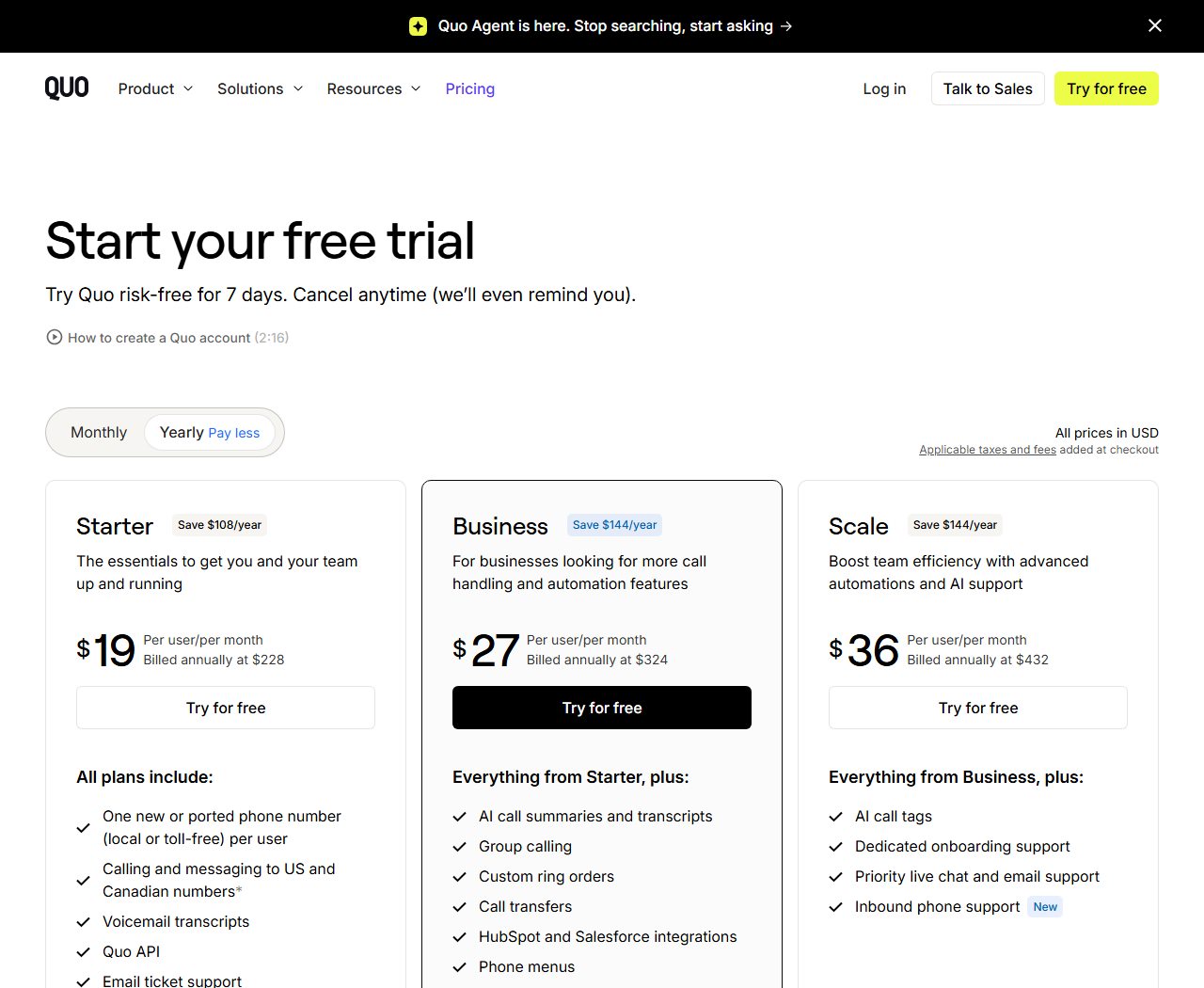
Scroll down the same page to "Compare plans" and the numbers change. Monthly reads $19, $33 and $47; yearly reads $15, $23 and $35. No note on the page explains the gap.
Our arithmetic says the cards are the trustworthy half. Starter at $28 a month is $336 a year, less $228 billed annually, which is exactly the $108 saving the badge claims. The table's figures do not reconcile with any badge on the page.
The practical move is the dull one: confirm the figure at checkout before the 7-day trial ends, and screenshot it. Prices on this page may have moved since October 23, 2026.
What you pay on top of the subscription
The subscription is not the bill. US business texting carries third-party carrier fees that Quo discloses on the pricing page but does not include in the headline price.
- Carrier review and setup — $19.50 one-time. Charged by The Campaign Registry to screen your business before major US carriers will deliver your texts reliably.
- Messaging fee — $1.50 to $3 per month, also from The Campaign Registry, to keep that standing.
- Additional phone numbers — $5 per month each. One number per user is included.
- Automated SMS through the API, Zapier or Make — 1 cent per segment.
- International calling and messaging — per-minute and per-message rates, billed using credits.
Sona is the line item that can move
Every plan includes 1,000 automation credits, which the page converts to 10 Sona calls, at 100 credits per call. Past that you pay $1.00 per call on the free tier.
Credit bundles run $25 a month for 4,000 credits, $49 for 10,000, $99 for 25,000 and $199 for 60,000, with overage falling from $0.75 to $0.45 per call as the tier rises.
Editorial arithmetic from the figures above: one person on Starter with US texting enabled pays $228, plus $19.50 once, plus $18 to $36 a year in messaging fees. Call it $265 to $284 in year one, before a single Sona overage.
That is still cheaper than most invoicing subscriptions on this site. For scale, see what FreshBooks, Bonsai and Harvest ask for a single seat.
Porting, security and what happens if you leave
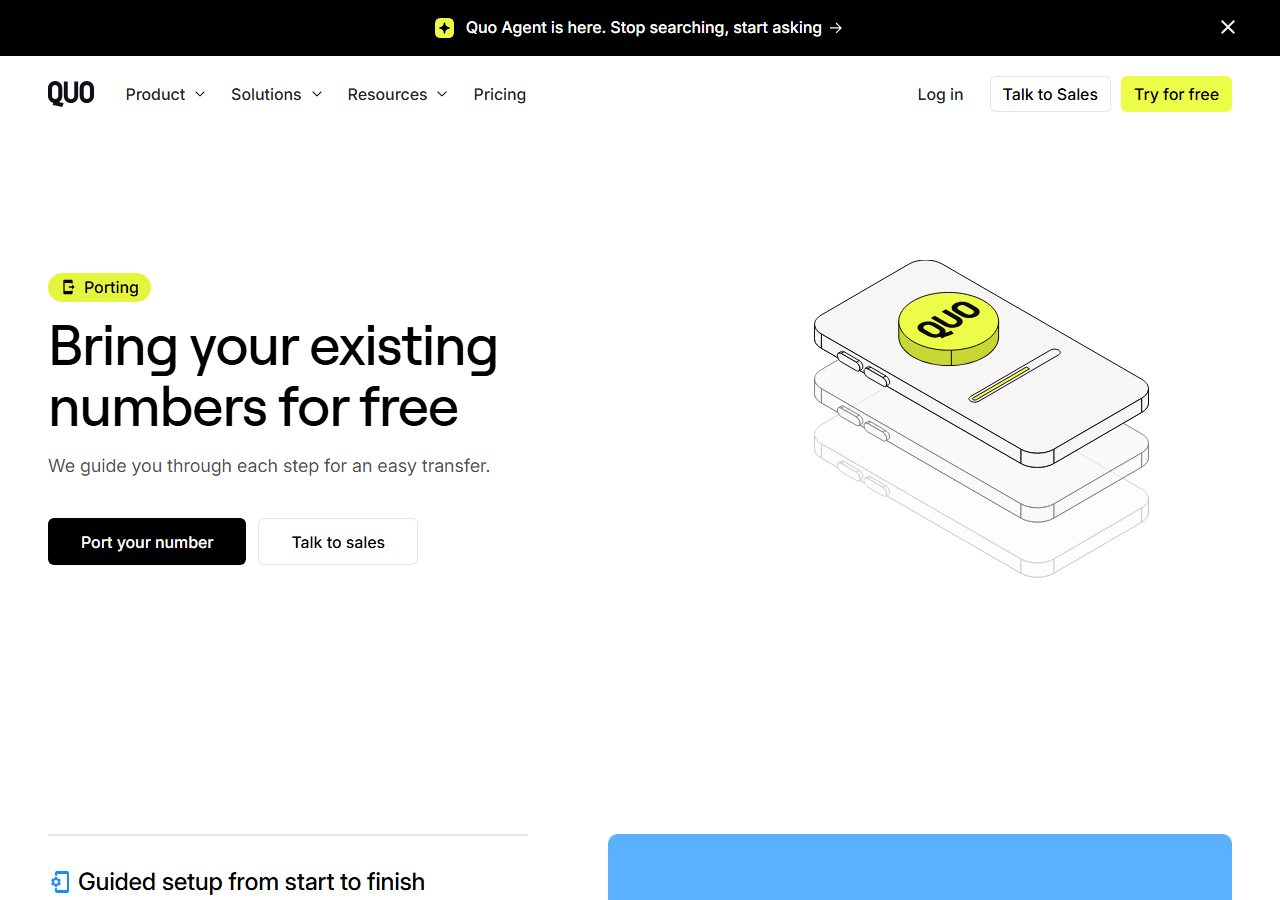
Porting an existing number in is free. Quo's porting page states the transfer "takes anywhere between 2 and 4 weeks and depends on how fast we hear back from your current phone service provider."
Have these ready before you start, per that page: carrier name, account name and number, billing address, your PIN or transfer authorisation, and a recent bill.
On security, the vendor claims SOC 2 Type II certification, HIPAA compliance with Business Associate Agreements available, TLS 1.2+ in transit, AES-256 at rest, and GDPR and CCPA compliance. Hosting is on AWS and Google Cloud.
Two claims deserve a flag. "99.999% uptime" is the vendor's own figure with no published status history behind it on that page, and the SOC 2 report itself sits behind "Talk to Sales" on every plan.
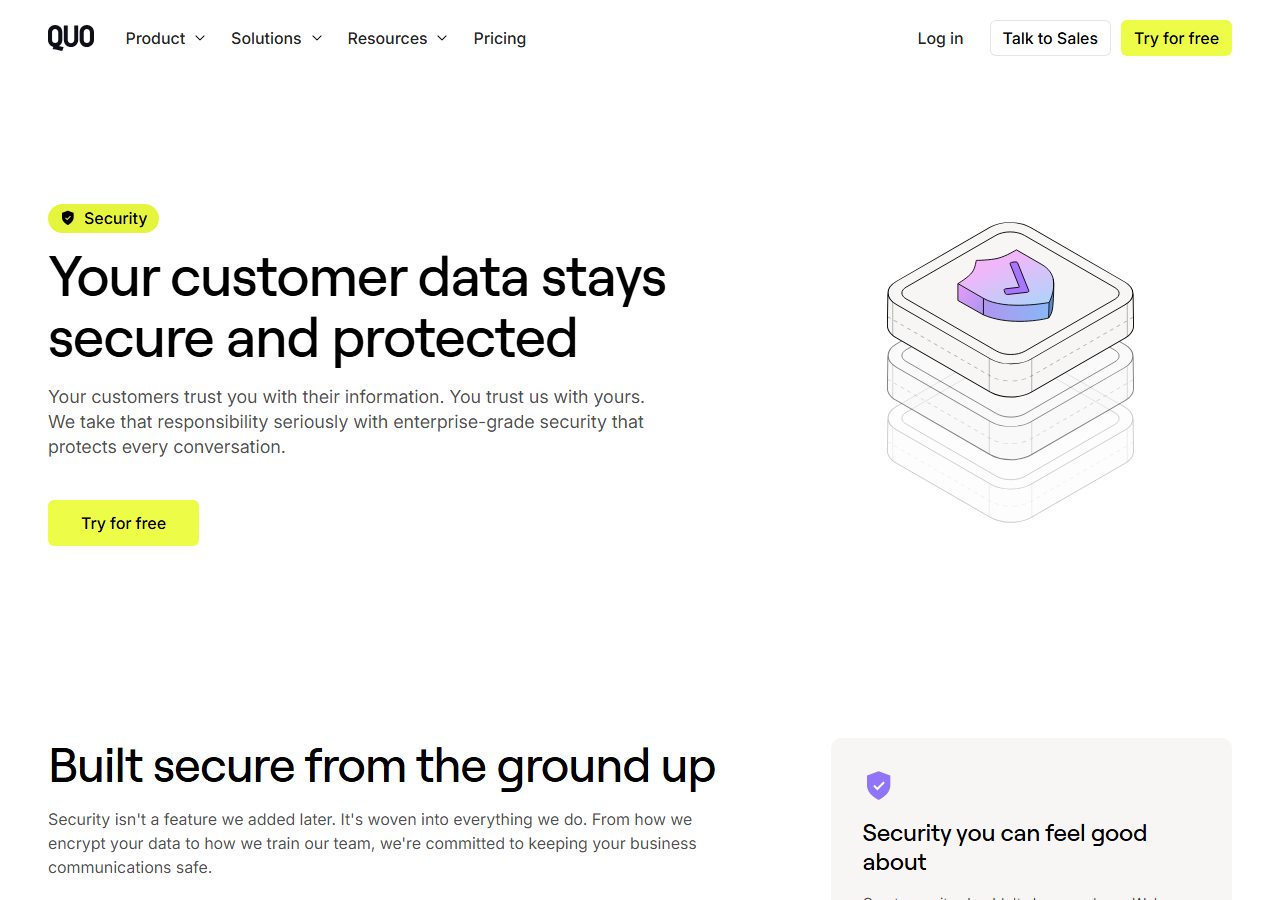
Leaving is addressed directly. The security page says you can "export your conversations, contacts, and call history whenever you want" and states plainly: "We don't sell your data. Ever."
The real exit cost is the number, not the data. A ported-in number has to be ported out again, which is the same two-to-four-week wait in reverse — a cost worth putting into the cancel decision before you commit.
What users report, and where the complaints cluster
Public feedback is good on average and unusually split underneath. Trustpilot showed a 4.2 TrustScore from 1,104 reviews when we checked on October 23, 2026.
The distribution is the part worth reading: 72% five-star, 5% four-star, 2% three-star, 2% two-star and 19% one-star. Very few people land in the middle.
Praise clusters on three things — a clean interface, fast setup, and support that answers. Complaints cluster just as tightly on app freezes, service interruptions, and call transfers dropping callers into voicemail.
That shape fits a product that works well until the connection or the backend does not, which matches what reviewers elsewhere report about calls over data. Budget for a backup way to be reached.
Quo's own figures, read on its homepage October 23, 2026: "4.7 stars | 3,400+ reviews", "Powering conversations for 90,000+ businesses", and "Quo is the #1 business phone in customer satisfaction on G2." The 4.7 badge does not name its source beside it.
Buy it if, skip it if
- Buy it if your personal mobile number is already your business number and you want that separated before it becomes harder to undo.
- Buy it if missed calls cost you work. Sona answering 10 calls a month at no extra charge is the clearest value in the Starter plan.
- Buy it if $228 a year for one seat is a rounding error against what one recovered client is worth to you.
- Buy it if you want a number that moves off your SIM, since porting in costs nothing but time.
- Skip it if you need a free number. A 7-day trial is the whole of the free access.
- Skip it if your work is mostly international voice. Those minutes are add-ons billed in credits, not part of the unlimited allowance.
- Skip it if call reliability is non-negotiable and your connection is not. The one-star reviews are concentrated here.
Frequently asked questions
Does Quo have a free plan?
No. The pricing page offers a 7-day free trial on all three plans, with "cancel anytime" and a stated reminder before it ends. After that the cheapest entry is Starter at $19 per user per month billed annually, checked October 23, 2026.
How much is Quo for one person?
$228 for the year on Starter, which the plan card prices at $19 per user per month billed annually. Add $19.50 once and $1.50 to $3 a month in carrier fees if you send business texts in the US.
Is Quo the same as OpenPhone?
Yes. OpenPhone renamed itself Quo on September 23, 2025, the same day it announced $105 million in growth financing. The company stated the product itself was not changing. Some pricing-page copy still reads "OpenPhone" as of October 23, 2026.
Can I keep my existing phone number?
Yes, and Quo does not charge for the port. Its porting page gives a window of two to four weeks, depending on your current provider, and says most customers see no service interruption during the transfer.
What does Sona cost once the free credits run out?
$1.00 per call on the included tier. Bundles start at $25 a month for 4,000 credits, which the page equates to 40 calls, and rise to $199 for 60,000 credits with overage at $0.45 per call.
Can I use Quo from outside the United States?
Yes for North American numbers. The comparison table states you can call US and Canadian numbers from any country with an internet connection at no additional charge, subject to the fair usage policy. Other destinations carry per-minute rates.
Bottom line
Quo is a reasonable first business line for a one-person operation at $228 a year, provided you treat that as roughly $265 to $284 in year one once US texting fees land.
The reservations are specific rather than general. Two conflicting price sets on one page, a 19% one-star share on Trustpilot, and an uptime claim with nothing published behind it.
None of those are reasons to avoid it. They are reasons to confirm the price at checkout, keep a second way to be reached, and decide during the trial week rather than in month six.
If it earns the renewal after that, it is cheap for what it does.
Start Quo's 7-day free trial →
Related reading on this site: our guide to invoicing tools for freelancers, the Calendly and Acuity comparison, and single reviews of Cal.com, Calendly, SignWell and Expensify.
Sources, all read October 23, 2026: quo.com (homepage claims), quo.com/pricing (plan prices, add-ons, Sona credits, plan limits), quo.com/security (certifications, encryption, data export), quo.com/porting (porting cost and timeframe), quo.com/blog/next-chapter (rebrand date and financing), trustpilot.com/review/quo.com (rating and distribution).