 My

Proton Pass
A free tier that includes ten email aliases and a paid tier that contradicts its own vault limit in the FAQ beneath it
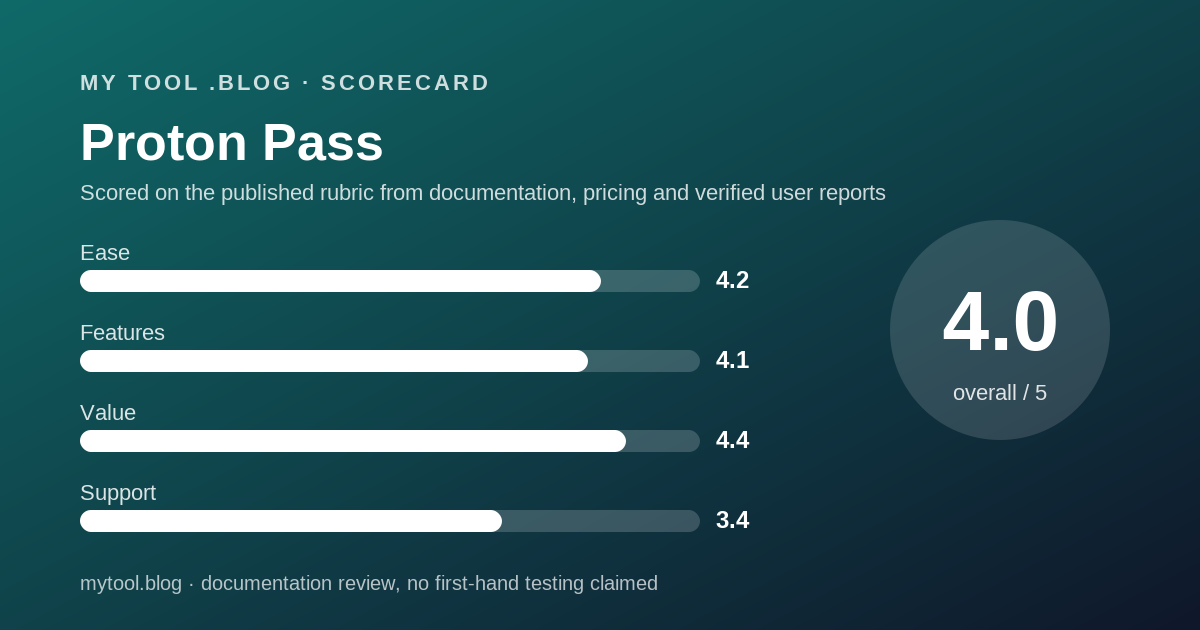
Scored on the published rubric, from documentation, pricing and verified user reports.
Best for: A freelancer who signs up for a lot of client tools and wants a throwaway email address for each one without paying for a second service.
Verdict
What this review is based on: the Proton Pass pricing page, its four plan cards, its 30-row plan comparison table and its five-question FAQ, plus the separate Proton Pass for Business pricing page, all read from the rendered pages on November 2, 2026 and confirmed a second time from the page source. No account was opened. On this blog that is the documentation review label, the third of the three honest positions.
The reason a freelancer should look at this one is the alias generator. The free plan includes 10 hide-my-email aliases, which is a feature most competitors sell separately.
For anyone who signs up to a new client portal every month, that is the single most useful line on the page.
The second finding is a contradiction. The comparison table caps paid plans at 50 vaults. The FAQ directly beneath it says a paid plan gives unlimited vaults, then adds that at 50 you should reach out for more.
Both statements are on the same URL, read the same day.
Visit Proton Pass
We have no affiliate relationship with this vendor. Link goes to the official site.
Where it is strong
- **The free plan includes 10 hide-my-email aliases**, listed on the Proton Free card and confirmed in the comparison table. Paid plans move that to unlimited (pricing page, November 2, 2026).
- **A 30-day money-back guarantee is printed on the page**, directly under the plan cards, and the FAQ explains it applies to Pass Plus and Proton Unlimited.
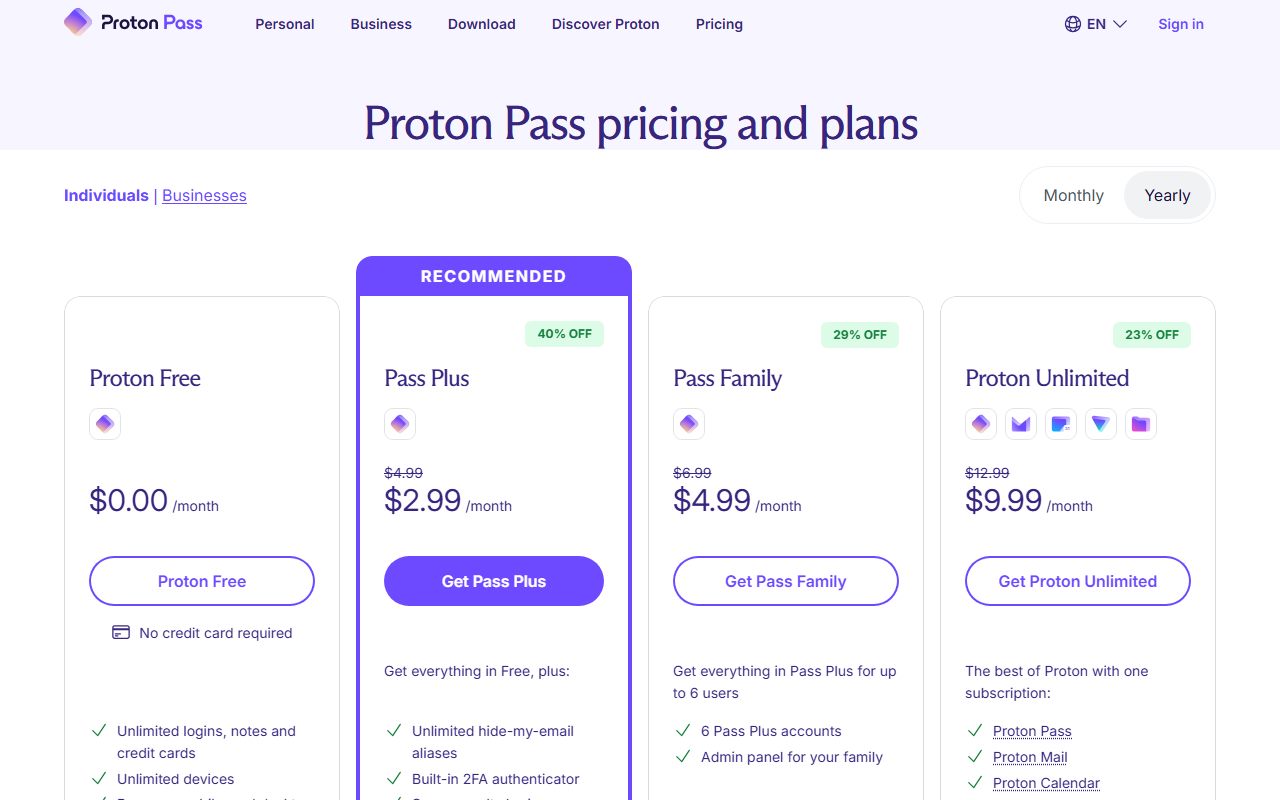
- **Every discount tag matches the arithmetic.** The 40, 29 and 23 percent tags line up with the gap between struck and current prices to within a percentage point, by our arithmetic.
- **Every annual total multiplies out exactly.** $2.99, $4.99, $9.99 and $12.99 give $35.88, $59.88, $119.88 and $155.88 respectively, all printed on the page.
- **The free plan is not device-limited.** Unlimited logins, unlimited credit cards, unlimited devices and passkey support across devices are all marked included on Proton Free.
- **Swiss jurisdiction is stated on the page**, not implied, in a block explaining that data is covered by Swiss privacy law.
Where it falls short
- **The page contradicts itself on vault limits.** The comparison table prints 50 vaults for paid plans; the FAQ on the same page says a paid plan allows unlimited vaults and to ask for more past 50.
- **The plan cards and the comparison table disagree about vault sharing.** The Pass Plus card sells secure vault sharing as an upgrade; the table grants Proton Free sharing with 2 others.
- **The struck-through prices are not labelled.** A Monthly and Yearly toggle exists, but only yearly figures rendered on November 2, 2026, so what $4.99 refers to is not stated.
- **Integrated two-factor codes are paid only.** The table marks integrated 2FA as absent from Proton Free, which is the feature most likely to push a freelancer onto a paid plan.
- **The business page prints an annual total for only one of its four plans.** Pass Essentials, Pass Professional and the VPN bundle show a monthly figure with no yearly total beneath.
At a glance
| Starting price | $0.00 (Proton Free), then Pass Plus printed at $2.99 a month, billed at $35.88 every 12 months |
|---|---|
| Pricing note | Proton Free $0.00; Pass Plus $2.99 a month with $4.99 struck through, billed at $35.88 every 12 months; Pass Family $4.99 a month with $6.99 struck through, billed at $59.88 every 12 months; Proton Unlimited $9.99 a month, billed at $119.88 every 12 months (pricing page, checked November 2, 2026) |
| Free plan | 1 GB storage, 2 vaults, sharing with 2 others, 10 hide-my-email aliases, unlimited logins, unlimited devices, passkeys |
| Paid personal tiers | Pass Plus $35.88 a year; Pass Family $59.88 a year for 6 users; Proton Unlimited $119.88 a year including Mail, Calendar, VPN and Drive |
| Business tiers | Pass Essentials $1.99 and Pass Professional $4.99 a user a month; VPN and Pass Professional $10.99; Workspace Standard $12.99 billed at $155.88 every 12 months |
| Storage | 1 GB on Free, 10 GB on Pass Plus, 50 GB on Pass Family, 500 GB on Proton Unlimited |
| Vaults | 2 on Free, 50 on each paid plan per the comparison table; the FAQ on the same page says unlimited |
| Refunds | 30-day money-back guarantee printed under the plan cards and explained in the FAQ |
| Trial | No trial length printed; the refund window stands in for one |
| Support | The comparison table row reads fast and friendly customer support and is marked included on all four plans, with no response time given |
| Jurisdiction | Switzerland, stated on the page |
What this review is based on, and what it cannot tell you
The sources are two Proton pages: the Proton Pass pricing page and the separate Proton Pass for Business pricing page. Both were read from the rendered page on November 2, 2026.
Every price below was then read a second time from the page source, so each figure comes from two tools pointed at the same URL.
No account was opened and no plan was purchased. This review can tell you what Proton charges and promises, and where its own page disagrees with itself.
It cannot tell you how the autofill behaves on a stubborn client login form.
Where the page prints a number, that number is quoted with the date. Where it is silent, this review says so, as set out in what this blog will and will not claim.
What Proton Pass is, and why the aliases matter more than the vault
Proton Pass is a password manager inside a wider Proton account that also covers mail, calendar, VPN, drive and more.
The vault part is unremarkable in a good way. Logins, notes, cards, passkeys, apps for Android, iOS, Windows, macOS and Linux, plus extensions for Chrome, Safari, Edge, Firefox and Brave.
The part worth a freelancer's attention is hide-my-email. Each time you sign up for something, Proton can mint a throwaway address that forwards to your real inbox.
Proton Free includes 10 of these. Every paid plan is marked unlimited in the comparison table.
That is a meaningful line for anyone who creates an account on a new client's portal most months.
The free plan, in the page's own numbers
Proton Free prints $0.00 a month and the card says no credit card required.
The card then lists unlimited logins, notes and credit cards, unlimited devices, the browser, mobile and desktop apps, a password generator, 10 hide-my-email aliases, alerts for weak and reused passwords, passkeys on all devices, and easy password import.
The comparison table adds three ceilings the card does not show. Storage is 1 GB. Vaults are capped at 2. Vault sharing is capped at 2 others.
What Free does not get, per the table, is integrated two-factor codes, item history, file attachments, dark web monitoring, emergency access and the command line interface.
That list is the real upgrade pitch, not the aliases.
Who this fits
The fit here is narrower than Proton's marketing suggests, and it comes down to email aliases and refunds.
- A freelancer who opens accounts on client tools constantly and wants each one isolated behind an alias
- Anyone who wants a refund window in writing before handing over a card, which this page prints
- A contractor who already pays for Proton Mail or VPN and can fold the password manager into one bill
- Someone who keeps contracts or identity scans in the vault, since file attachments start on the first paid tier
- A two-person studio weighing an all-in-one suite against single-purpose tools
- Anyone who cares where the company is incorporated, because Swiss jurisdiction is stated on the page
Who should skip Proton Pass
Three groups should read a different price list first.
- Anyone who wants two-factor codes without paying, because the table marks integrated 2FA as paid only
- Anyone who wants the cheapest annual price in the category, which is $16.08 lower elsewhere by our arithmetic
- Anyone who needs a hard, single answer on vault limits, which this page does not currently give
How the pricing is structured, and what the toggle will not show you
There are four personal plans. Proton Free at $0.00, Pass Plus at $2.99 a month, Pass Family at $4.99 a month and Proton Unlimited at $9.99 a month.
Under each paid card sits the annual total: $35.88, $59.88 and $119.88. All three multiply out exactly from the monthly figure, which is more than several price lists in this cluster manage.
Each paid card also carries a struck-through figure and a discount tag: $4.99 and 40 percent off, $6.99 and 29 percent off, $12.99 and 23 percent off.
Our arithmetic on those gaps gives 40.1, 28.6 and 23.1 percent, so the tags are accurate.
What is missing is the label. A Monthly and Yearly toggle exists, but only the yearly figures rendered on November 2, 2026.
The vault limit is printed two different ways on one page
This is the contradiction to resolve before you pay.
The comparison table has a row called organize stored items in vaults. It prints 2 vaults on Proton Free and 50 vaults on each of the three paid plans.
The FAQ sits directly beneath that table. Its answer to the difference between free and paid plans reads: with a paid Proton plan you can create unlimited vaults, and once you reach 50 vaults, just reach out and we can help you create more.
So the paid cap is either 50, or unlimited on request. Both readings are on the same URL, read the same day.
For most freelancers 50 vaults is academic. Print the sentence anyway if you intend to run a vault per client.
The cards and the table also disagree about sharing
The second disagreement is smaller but points the same way.
The Pass Plus card is headed get everything in Free, plus, and the third item under it is secure vault sharing. Read alone, that says vault sharing is a paid feature.
The comparison table says otherwise. Its securely share vaults row prints 2 others on Proton Free and 10 others on each paid plan.
So free users can share a vault, with two people, and the card does not mention it.
A separate row, securely share individual items, is marked paid only. That is probably the distinction the card meant to draw, and it does not draw it.
What each paid tier buys, in the order a freelancer misses it
Pass Plus at $35.88 a year adds the features most likely to matter day to day.
The table marks integrated 2FA, item history, file attachments, dark web monitoring, Proton Sentinel account protection, emergency access and the command line interface as included from Pass Plus upward.
It also moves aliases from 10 to unlimited, storage from 1 GB to 10 GB, vaults from 2 to 50 and vault sharing from 2 people to 10.
Pass Family at $59.88 a year is six Pass Plus accounts plus an admin panel, which our arithmetic makes $9.98 per person per year.
Proton Unlimited at $119.88 a year folds in Mail, Calendar, VPN and Drive with 500 GB of storage.
The business page prices four plans and totals only one
Proton Pass for Business is a separate page with four cards, read the same day.
Pass Essentials prints $1.99 with a 60 percent off tag. Pass Professional prints $4.99 with 29 percent off. VPN and Pass Professional prints $10.99 with 18 percent off. Workspace Standard prints $12.99 with 13 percent off.
Only Workspace Standard carries an annual total: billed at $155.88 every 12 months, which multiplies out exactly.
The other three cards show a monthly figure and no yearly total. Our arithmetic puts Pass Essentials at $23.88 a user a year, but the page does not do that sum for you.
For a sole trader the personal plans are cheaper and no less capable.
Support is marked included everywhere and quantified nowhere
The comparison table has one support row. It reads fast and friendly customer support, and it is marked included on all four plans including the free one.
There is no response-time commitment, no live chat promise and no phone number anywhere on the pricing page read November 2, 2026.
For a password manager that is a defensible position. The thing you need working is the extension, not the queue.
It is still less than the e-signature vendors in our signature cluster put in print.
The refund window partly compensates. A 30-day money-back guarantee is a stronger commitment than a vague support promise.
What the page does not publish
Three things a freelancer would want are absent from the two Proton pages read November 2, 2026.
There is no monthly-billing price, because only the yearly view rendered and the struck-through figures are unlabelled. There is no trial length. There is no support response time.
There is also no seat minimum stated for the business plans, so nothing printed stops one person buying one Pass Essentials seat.
None of those gaps is dishonest. They are the questions to settle before a renewal, which is the habit behind counting what a tool costs besides its price.
The 30-day refund window is the one that does most of the work here.
Alternatives worth reading the price list of
Two alternatives sit either side of this one on price.
Bitwarden is cheaper. Its free plan carries unlimited passwords with no vault cap printed, and Premium is $19.80 a year against $35.88 here, a gap of $16.08 by our arithmetic. It prints no refund window at all.
1Password is dearer and has no free plan. Its small-business page also disagrees with its own FAQ about what a ten-person pack costs.
Choose Bitwarden if the lowest annual price wins. Choose Proton Pass if the aliases and the refund window are worth $16.08 a year.
That is the same trade we ran across the invoicing cluster: cheapest is not always the renewal you keep.
Buy it if, skip it if
Buy Pass Plus if you open client accounts often and want an alias for each, which is the one thing here you cannot get cheaper elsewhere.
Buy Proton Unlimited only if you were already going to pay for encrypted mail, a VPN or cloud storage, otherwise it is four products you will not open.
Stay on Proton Free if you need a vault and nothing else, and accept that two-factor codes live on a paid tier.
Skip Proton Pass if you want the lowest annual price, or if an unresolved vault limit in print bothers you.
It is a reasonable keep-or-cancel call of the kind described in how to decide to cancel a tool you pay for.
Bottom line
Proton Pass is the best-priced alias generator in this category that happens to come with a competent password manager attached.
If you want the cheapest vault, this is not it. Bitwarden is $16.08 a year less by our arithmetic and prints no vault cap.
If you want a disposable email address for every client tool, plus a refund window in writing, the $35.88 is easy to justify.
Two things to settle before paying: whether your paid plan allows 50 vaults or unlimited, and what the struck-through prices refer to.
Both are questions the page itself created, and both are answerable in one message to support before the card goes in.
Sources
Proton Pass pricing page, four plan cards with discount tags and annual totals, read November 2, 2026.
Proton Pass pricing page, 30-row plan comparison table and the five-question FAQ beneath it, read the same day.
Proton Pass for Business pricing page, four cards, read the same day.
All prices were confirmed a second time from the page source on the same URLs. Every multiplication and percentage above is the arithmetic of this blog, built only from printed figures.
Related reading: Dropbox Sign for a vendor that prints its limits plainly, and Cal.com for another open-source free tier.
Buy it if
- You sign up for new client tools often and want a disposable alias for each one without a second subscription
- You want a printed refund window, because the 30-day guarantee is on the page in plain text
- You already use Proton Mail or Proton VPN, in which case Proton Unlimited replaces several lines on your card statement
- You want encrypted file attachments inside the vault, which the table marks as paid on all three paid tiers
Skip it if
- You need two-factor codes in the free vault, which the comparison table marks as a paid feature
- You want a firm vault ceiling in writing, since the table and the FAQ beneath it disagree
- You want the lowest annual price in the category, which is $16.08 cheaper elsewhere by our arithmetic
Frequently asked
Is Proton Pass free?
Yes. The Proton Free card read November 2, 2026 prints $0.00 a month with no credit card required, and lists unlimited logins, unlimited devices, 1 GB of storage, 2 vaults and 10 hide-my-email aliases.
How much does Pass Plus cost?
The card prints $2.99 a month with $4.99 struck through and a 40 percent off tag, and the line beneath reads billed at $35.88 every 12 months. That multiplication checks out exactly.
What do the hide-my-email aliases do for a freelancer?
They let you give each client portal or vendor its own throwaway address. Proton Free includes 10 of them; all three paid plans are marked unlimited in the comparison table read November 2, 2026.
How many vaults does a paid plan allow?
The page gives two answers. The comparison table prints 50 vaults for every paid plan. The FAQ on the same page says a paid plan allows unlimited vaults and that past 50 you should contact support. Confirm at checkout.
Is there a free trial or a refund?
No trial length is printed. Instead the page states a 30-day money-back guarantee, and the FAQ confirms it applies to Pass Plus and Proton Unlimited if you cancel and request a refund within 30 days.
Is Pass Family worth it for a two-person studio?
Possibly. Pass Family is $59.88 a year for up to 6 users, which our arithmetic puts at $9.98 per person per year, against $35.88 for a single Pass Plus account.
Does a freelancer need the business plan?
Rarely. Pass Essentials is printed at $1.99 a user a month, which our arithmetic makes $23.88 a user a year, but the business page does not print that annual total for you.
Sources
- Proton Pass pricing page: four plan cards, discount tags and annual totals - checked November 2, 2026
- Proton Pass pricing page: plan comparison table and five-question FAQ - checked November 2, 2026
- Proton Pass for Business pricing page: Pass Essentials, Pass Professional, VPN bundle, Workspace Standard - checked November 2, 2026
Visit Proton Pass
We have no affiliate relationship with this vendor. Link goes to the official site.